Loose tablet billing: selling part of a strip the right way
Selling 4 tablets from a strip of 10 is where pharmacy stock usually goes wrong. Count stock in units, price per tablet within MRP and keep returns in the same batch.
By Med Dukaan TeamUpdated 3 min read
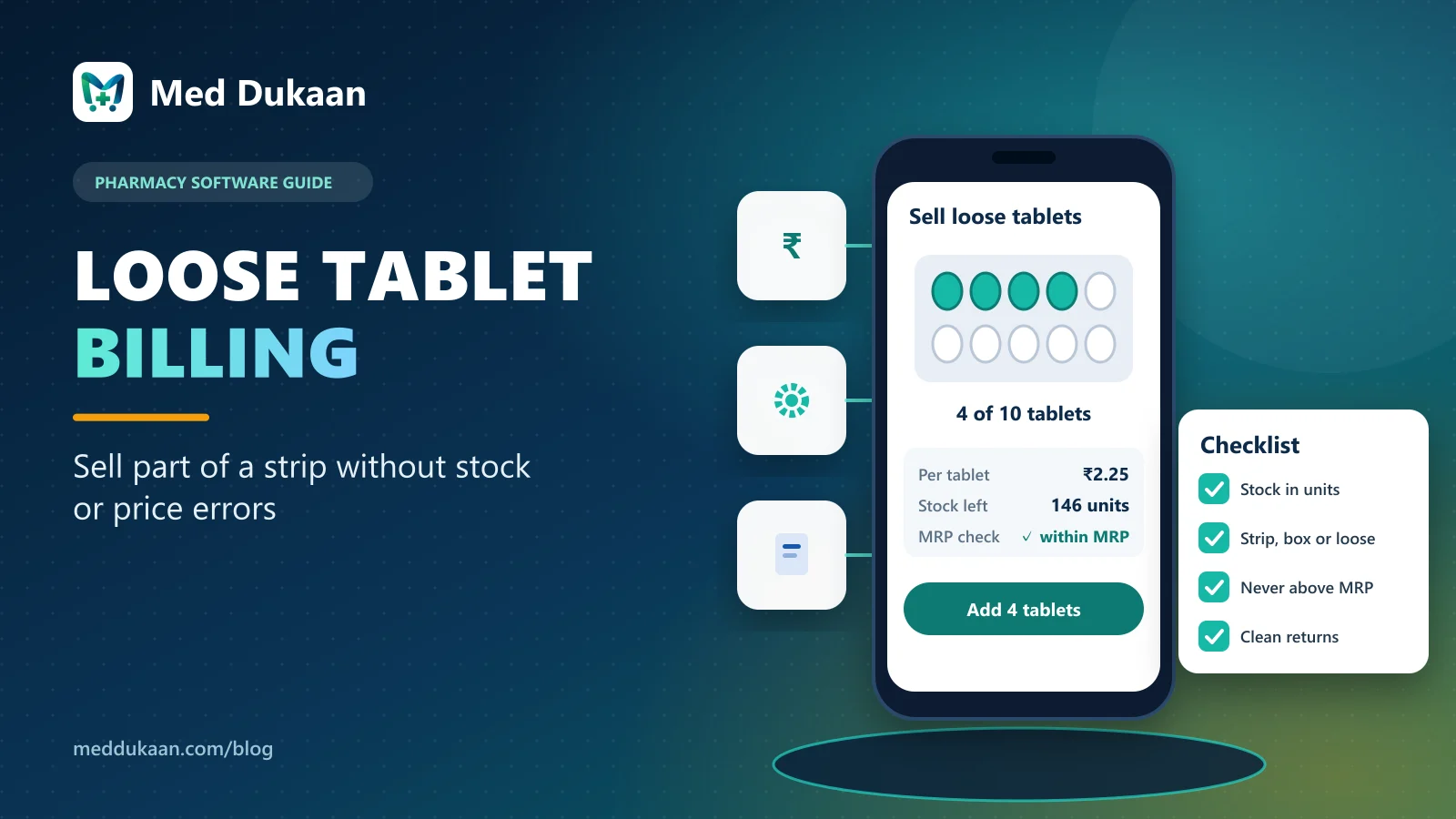
To bill loose tablets correctly, the software must count stock in single units, know how many units are in a pack, and price each tablet at or below MRP per unit. Then selling 4 tablets from a strip of 10 reduces stock by exactly 4, the price is fair, and the strip count still matches the shelf.
Loose sales are normal in Indian pharmacies, especially for antibiotics, painkillers and chronic medicines bought a few days at a time. Done by hand, they are also where stock quietly goes wrong.
Key takeaways
- Keep stock in units (tablets, capsules, pieces), sell in units, packs or boxes.
- Set units per pack and whether loose sale is allowed for each medicine.
- Default loose price = pack price ÷ units, never above MRP per unit.
- Prescription rules do not change for loose sales.
- Returns of loose tablets go back into the same batch.
Why does loose selling break stock counts?
If software counts "strips", selling 4 tablets forces a choice: count it as a strip (stock too low) or not at all (stock too high). After a few weeks nobody trusts the numbers. The fix is to count everything in units and convert for display.
How should a medicine be set up for loose sale?
For each medicine, Med Dukaan asks:
- Units in one pack: 10 tablets in a strip, 15 capsules, or 1 for a bottle.
- Packs in a box: if you also sell by the box.
- Allow loose sale: on for tablets and capsules you split, off for things you never open.
- Counter starts with: loose unit, pack or box, whichever you sell most.
How is the loose price worked out?
By default, the loose price is the pack price divided by the units. You can set your own loose price, for example to round to a convenient amount, but Med Dukaan never charges more than MRP per unit.
| Pack | MRP | Units | Default price per tablet |
|---|---|---|---|
| Strip of 10 | ₹22.50 | 10 | ₹2.25 |
| Strip of 15 | ₹168.00 | 15 | ₹11.20 |
Prices are examples for illustration.
Do prescription rules change for loose sales?
No. A Schedule H or H1 medicine sold loose still needs the prescription details recorded, and only a pharmacist role can bill it. Selling fewer tablets does not make it an OTC sale.
What about returns?
If a customer returns loose tablets, the return goes back into the same batch, in units, with a credit note. Your strip count stays correct.
A weekly habit that keeps counts honest
Pick the open strips of your top ten loose sellers once a week and count them. Because stock is in units, any difference shows up immediately and can be adjusted with a reason.
Illustrative example
Fictional example. A cashier sells 6 tablets of an antibiotic from a strip of 10 for a two-day course. The screen shows 6 units, the per-tablet price within MRP, and 4 units left in that opened strip. The next customer who needs 4 tablets gets the same strip first.
Common mistakes
- Treating a loose sale as a full strip "to keep it simple".
- Setting a loose price above MRP per unit by rounding up.
- Allowing loose sale on items that are never opened.
Loose selling is built into Med Dukaan's billing counter. See pricing or book a demo.
Frequently asked questions
How do I sell loose tablets in pharmacy software?
Set units per pack and allow loose sale for the medicine. At the counter choose loose units and enter the number of tablets; stock reduces by exactly that many units.
Can the loose price be higher than MRP per tablet?
No. Med Dukaan never charges more than MRP per unit for a loose sale.
Do Schedule H medicines need a prescription when sold loose?
Yes. Prescription details are still recorded and only a pharmacist role can bill Schedule H and H1 medicines.
Where do returned loose tablets go?
Back into the same batch, counted in units, with a credit note.
- #billing
- #loose tablets
- #POS
Product team, Appluk Private Limited
The people who build Med Dukaan, pharmacy software for Indian medical stores. We write about how the software works and how stores use it day to day.